
A generator that works fine for weekend camping or occasional home backup will struggle on a construction site. Job sites run power tools with heavy startup surges, operate for 8–10 hours a day rather than occasionally, sit outdoors in dust and weather, and — increasingly — have to meet noise limits in urban areas. Picking the wrong unit doesn’t just mean an inconvenience; it means tripped breakers, stalled crews, and lost hours on a schedule where delays cost real money.
Here’s what actually determines the right generator for a job site, based on how the top-performing construction and rental industry guides approach the decision.
Why Job Site Power Needs Are Different From Home Backup
A home backup generator typically runs a refrigerator, some lights, and a router — steady, predictable loads. A construction site runs power tools, compressors, and lighting rigs that draw a large surge of “starting watts” the moment they’re switched on, often several times higher than their “running watts.” A circular saw or air compressor that pulls 1,500 running watts might momentarily demand 3,000+ watts on startup. If your generator can’t cover that surge, breakers trip and equipment can’t start — even if your total running load looks fine on paper.
Job sites also run generators far closer to continuously than a home unit ever does, which raises different priorities: fuel consumption over long shifts, resistance to dust and weather, and how easy the unit is to refuel and relocate as work moves across the site.
Sizing a Generator for Your Job Site
Sizing mistakes go both directions, and both are expensive:
- Undersizing causes tripped breakers, stalled tools, and — if you run a generator consistently under about 50% of its rated capacity — a problem called wet stacking, where unburned fuel builds up in the engine and drips from the exhaust, reducing efficiency and shortening engine life over time.
- Oversizing wastes fuel and adds unnecessary purchase cost for capacity you’ll rarely use.
The general rule industry guides converge on: run your generator at roughly 70–90% of its rated capacity. To get there:
- List every tool and piece of equipment that could run at the same time, and note each one’s running watts.
- Add the highest starting-watt figure among them on top of your total running watts — most sites don’t start every tool at once, so you only need to cover the largest single surge, not every tool’s startup simultaneously.
- Add a 20–25% buffer on top of that total to avoid running right at the generator’s ceiling.
For a small crew running a couple of power tools and a work light, a 3,000–5,000W portable unit is often enough. Larger crews running compressors, welders, or multiple simultaneous tools will need to size up accordingly, or plan for a higher-capacity or three-phase unit.
Portable vs. Larger Stationary Generators
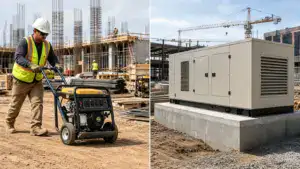
Not every job site needs the same category of generator:
- Portable generators make sense for smaller crews, multi-site contractors, remodels, and any job where the generator needs to move as work progresses. They’re quick to deploy, need no site prep, and can be relocated within the site or trucked to the next job without any teardown.
- Larger stationary or towable units make more sense for large-scale builds where the generator stays in one place for months and higher continuous capacity outweighs the value of mobility.
For most small-to-mid-size contractors and multi-site crews, portability wins — a generator that has to sit in one place for the life of a large-scale build is a different tool than one that needs to move between five smaller jobs in a month.
Why Fuel Type Matters More on a Job Site Than at Home
Diesel remains the standard for the largest stationary job-site generators because of its fuel efficiency and energy density at scale. But for small-to-mid-size portable units — which cover the majority of contractor and multi-site use cases — fuel choice comes with job-site-specific trade-offs that rarely apply at home:
- Gasoline is easy to source but degrades in storage — a real problem if a generator sits idle in a truck or storage yard between jobs, and a common cause of hard starts on equipment that hasn’t run in weeks.
- Diesel bulk storage on smaller sites can trigger additional spill-containment and storage regulations depending on jurisdiction, and diesel theft from job-site tanks is a persistent, well-documented problem in the industry.
- LPG doesn’t degrade in storage the way gasoline does, making it a better fit for generators that sit unused between jobs, and it sidesteps a lot of the bulk-storage compliance overhead that comes with diesel.
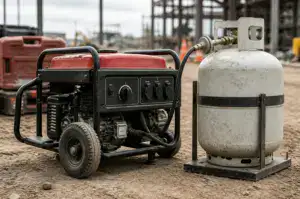
This is where multi-fuel (gasoline/LPG/NG) portable generators fit a real gap: rather than locking a crew into whichever fuel happens to be available or easiest to store between jobs, one unit can run on job-site gasoline, a stored LPG cylinder, or a site’s natural gas line depending on what’s on hand — without carrying separate single-fuel units to cover each scenario.
Durability and Weather Resistance
Job-site generators take more physical abuse than a home unit ever will. Look for:
- A frame built to handle vibration and rough transport, not just aesthetic housing
- Weather-resistant construction that tolerates rain, dust, and temperature swings without corroding internal components
- A copper-wound (rather than aluminum-wound) alternator, which holds voltage regulation better under the sustained heavy loads job sites produce
- Low-oil and overload shutoff protection, since job-site units often run for full shifts with less hands-on monitoring than a home backup unit gets
Noise: An Increasingly Real Constraint
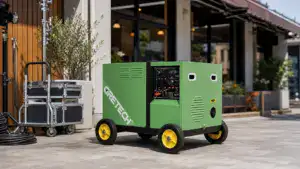
Urban construction sites, night-shift work, and jobs near residential areas increasingly operate under local noise ordinances — and a generator that’s too loud can become a compliance problem, not just an annoyance. Inverter-style and enclosed-frame generators run meaningfully quieter than open-frame conventional units, which matters directly if your crew works early mornings, late shifts, or in noise-restricted zones.
Safety Basics That Get Overlooked
- Run generators outdoors only, positioned away from doors, windows, and air intakes to avoid carbon monoxide buildup in trailers or enclosed site offices.
- Ground the unit properly per the manufacturer’s instructions before connecting tools.
- Don’t refuel a running or still-hot generator — let it cool first.
- Keep the generator on level, stable ground to avoid oil starvation or tipping, especially on sloped or uneven sites.
Which Generator Fits Your Job Site
- Small crews, remodels, multi-site work: a portable 3,000–5,000W inverter or standard generator, prioritizing weight and quick redeployment.
- Mid-size crews running compressors, welders, or several simultaneous tools: a higher-output portable unit (6,500–10,000W), sized with the 70–90% rule above.
- Noise-restricted or residential-adjacent sites: a quieter, enclosed-frame or inverter unit rather than a standard open-frame generator.
- Sites with inconsistent fuel access or generators that sit idle between jobs: a multi-fuel (gasoline/LPG/NG) unit that avoids fuel degradation and gives the crew flexibility in whatever’s actually available on site.
- Large-scale builds with a fixed footprint for months: a larger stationary or towable diesel unit, where continuous high capacity matters more than mobility.
The Bottom Line
The generator that keeps a job site running isn’t necessarily the biggest or the cheapest — it’s the one sized correctly for actual startup loads, durable enough for daily outdoor use, and fueled in a way that matches how the crew actually works between jobs. For contractors and multi-site crews specifically, that increasingly points toward portable, multi-fuel units that combine job-site-ready durability with the flexibility to run on whatever fuel is actually on hand.
Sourcing generators for a contractor fleet or distribution line? GRETECH manufactures CE/EU5-certified portable multi-fuel (LPG/NG/petrol) generators built for job-site duty, with wholesale pricing and OEM options available. Request Pricing →