
Most “portable vs standby” comparisons are written for a homeowner deciding what to install at one address. That framing doesn’t hold up once you’re sourcing 10, 50, or 500 units — for a rental fleet, a distributor’s product line, or a contractor’s job-site inventory, the deciding factors shift from “what’s automatic” to “what’s the cost and flexibility per unit at scale.” This piece breaks the comparison down from that angle, using published cost and outage data rather than single-household anecdotes.
The Core Difference, Reframed for Volume
A standby generator is a fixed, site-specific asset. It’s installed once, wired to one property’s panel and gas line, and stays there — permanently. Each unit is a single-site solution.
A portable generator is a deployable asset. The same unit can move between job sites, be redeployed to a different customer, or sit in inventory ready to ship — no site-specific installation ties it to one location.
That distinction is the whole reason distributors and rental fleets default to portable units for anything beyond a single fixed installation: standby generators don’t scale as inventory, portable ones do.
| Portable Generator | Standby Generator | |
|---|---|---|
| Unit economics | $500–$2,500 landed cost per unit | $7,000–$20,000 per site, fully installed |
| Deployment | Redeployable across sites/customers | Fixed to one site permanently |
| Fleet/inventory model | Stockable, resellable, reusable | Not resellable once installed |
| Installation labor | None — ship and use | Licensed electrician, permit, gas line, concrete pad per site |
| Fuel | Gasoline, LPG, natural gas — often switchable on one unit | Piped natural gas or propane, fixed to site infrastructure |
| Lead time to power-on | Minutes | Days to weeks (permitting + install) |
| Power range (typical) | 2,000–10,000W | 10,000–26,000W+ |
Why Volume Buyers Default to Portable
For a distributor or rental company, the standby model has a structural problem: each unit is committed to one customer’s property the moment it’s installed. There’s no way to hold standby inventory, reassign a unit, or move it to a higher-demand market if conditions change. Portable units don’t have that constraint — the same SKU can sit in a warehouse, ship to a distributor in another region, or get reassigned to a different rental customer at the end of a job. That flexibility is why rental fleets and equipment suppliers overwhelmingly stock portable and towable units rather than standby systems, reserving standby-style installs for direct site contracts only.
The Real Cost Comparison
Landed/installed cost data from 2026 sourcing and installation reports:
- Portable generators: $500–$2,500 per unit, with an optional transfer switch adding $400–$1,300 if the end customer wants one. No site work required — cost per unit stays flat whether you’re moving 10 units or 1,000.
- Standby generators: $7,000–$20,000 fully installed per site, with most 22kW systems landing between $9,000–$16,000 once you include the unit, transfer switch, concrete pad, gas hookup, permit, and licensed labor.
For a distributor, that’s not just a per-unit cost difference — it’s a difference in what the business model even looks like. Portable inventory turns over; standby installs are one-off, site-locked projects with electrician and permitting dependencies you don’t control.
What the Outage Data Says About Sizing
According to the U.S. Energy Information Administration (EIA), the average U.S. electricity customer experienced about 11 hours of power interruptions in 2024, up from roughly 5.5 hours in 2022 — but that figure is heavily skewed by major storm events. States like Arizona, South Dakota, and Massachusetts averaged under two hours of interruptions for the year, while hurricane-affected South Carolina averaged 53 hours.
For sourcing purposes, this means end-demand for backup power is not uniform — it spikes regionally around storm season and clusters around short-duration, essential-circuit needs the rest of the year. That’s a portable-generator demand pattern, not a whole-home standby one: most end customers need enough capacity to cover a refrigerator, some lighting, and communications equipment for a matter of hours, not days — which is exactly the segment portable units are priced and sized for.
Fuel Flexibility Matters More at Scale
Standby installations are locked to whatever fuel infrastructure exists at each site — natural gas or propane, decided at install time and expensive to change afterward.
Portable units historically meant gasoline-only, which creates real supply-chain friction for distributors: gasoline degrades in storage, complicating warehousing, and it’s typically the first fuel to sell out ahead of a storm — a bad combination for anyone stocking inventory ahead of seasonal demand. Multi-fuel portable generators — running on gasoline, LPG, and natural gas from a single unit — remove that constraint. A distributor can stock one SKU that serves customers regardless of which fuel is locally available, rather than carrying separate gasoline-only and propane-only lines to cover the same demand.
Safety & Compliance Considerations for Resale
This matters directly if you’re distributing rather than just using: the Consumer Product Safety Commission (CPSC) estimates roughly 85–100 U.S. deaths per year from carbon monoxide poisoning linked to portable generators, with the CPSC’s own testing recommending a minimum 20-foot clearance from structures — further than many manufacturer manuals state. The large majority of incidents involve indoor or garage use, not product defects.
For sourcing and resale, two things follow:
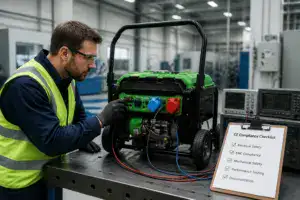
- Prioritize suppliers whose units include a built-in CO shutoff sensor — the CPSC estimates roughly 60% of newer portable generators now include this feature, and it’s increasingly treated as a baseline expectation rather than a premium add-on.
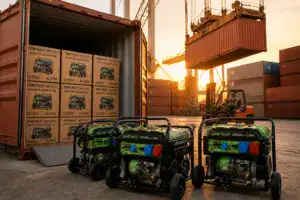
- Confirm CE/EU5 or destination-market certification is in place before committing to a container order — certification requirements vary by import market and are worth verifying per SKU, not assumed from a general product line.
Which Model Fits Your Line Card
- Stock portable (including multi-fuel) if: your customers are rental fleets, contractors, event suppliers, or residential/light-commercial end users who need deployable, resellable inventory rather than a single-site fixed install.
- Refer out or partner for standby if: a specific end customer needs a fixed, whole-property automatic solution — hospitals, data centers, or high-value single-site accounts where installation and permitting are part of the deal, not something you’re set up to manage as a distributor.
- Lead with multi-fuel portable SKUs specifically if: you’re supplying multiple regions or fuel environments and want one line card entry to cover gasoline, LPG, and natural gas markets instead of stocking three separate single-fuel product lines.
Bottom Line for Sourcing Decisions
Standby generators solve a single-site problem well but don’t function as tradeable inventory. Portable — and increasingly multi-fuel portable — generators are the format that actually scales as a product line: lower unit cost, no installation dependency, redeployable across customers and regions, and fuel flexibility that reduces the number of SKUs needed to cover a market. For distributors evaluating where to put warehouse and catalog space, the outage and cost data point the same direction the rental industry has already moved: toward portable as the deployable, revenue-generating format, with standby reserved for direct, site-specific contracts.
About GRETECH
GRETECH manufactures the full range of LPG/NG/petrol multi-fuel portable generators referenced throughout this comparison — from entry-level single-phase units to three-phase, inverter, and biogas variants — engineered around the leak-proof, output-matching mixing valve described above. The lineup is CE and EU5 certified, with country-specific certification support available for markets requiring SONCAP, SASO, or other import documentation. For distributors, rental fleets, and contractors evaluating a multi-fuel supplier, we offer OEM/ODM and private-label options, per-SKU MOQ and lead-time quotes, and sample units for factory verification before a container order.
Request Wholesale Pricing & Certification Documentation →
Sources: U.S. Energy Information Administration (EIA), “Today in Energy” reports on electric power interruption duration (2018–2025); U.S. Consumer Product Safety Commission (CPSC) reports on carbon monoxide fatalities associated with portable generators; Angi, HomeGuide, and CostToRenovate.com 2026 generator installation cost data.