
Becoming a portable generator distributor comes down to five things: a clearly defined market, the right product range, local compliance, a reliable manufacturer, and a plan for after-sales service.
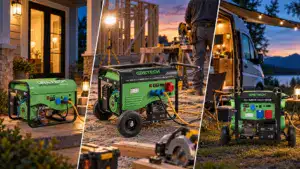
Why Portable Generators Are a Good Product to Distribute
Portable generators sell all year because the demand does not depend on one customer type. Homeowners buy them for outages, contractors for job sites, campers and RV owners for leisure, and rental companies for fleets. A distributor who serves two or three of these groups avoids relying on a single season.
Three features make the category attractive for distributors:
- Repeat orders. Stock moves quickly before storm and winter seasons, and dealers reorder when it sells through.
- Accessories and parts. Spark plugs, filters, covers, extension cords and gas hose kits add margin to each unit sold.
- A wide price ladder. A distributor can stock compact inverter units for camping, mid-size models for home backup, and larger open-frame units for work sites.
Fuel flexibility is now a real buying factor. Gasoline is hard to store for long periods, while LPG and natural gas keep well and are already connected to many homes and businesses. Tri-fuel generators, which run on gasoline, LPG and natural gas, give dealers a clear answer when a customer asks which fuel to rely on.
Distributor, Dealer or Retailer: Which Role Fits You?
The three roles buy from the manufacturer at different volumes and carry different responsibilities, so pick the one that matches your capital and your customers.
| Role | Buys from | Sells to | Main responsibilities | Best suited for |
|---|---|---|---|---|
| Distributor (importer) | The manufacturer, in container loads | Dealers, retailers, rental companies | Import and customs, stock holding, dealer support, spare parts, warranty handling | Established trading or equipment companies with warehouse space |
| Dealer | A distributor or the manufacturer | End customers and contractors | Sales advice, basic installation, first-line service | Equipment shops and electrical contractors |
| Retailer | A distributor or wholesaler | Consumers | Display, pricing, returns | Hardware chains, farm stores, online shops |
Many successful businesses start as dealers or small importers, then take on the distributor role for a country or region as volume grows. If you already supply tools, garden equipment or construction products, you have the customer base to begin as a distributor right away.
8 Steps to Become a Portable Generator Distributor
Step 1: Define your market and your customers
Start with the customers you can already reach. Retail chains, contractors, rental fleets, farm suppliers and installers each want different products and different support. Write down your top three customer groups and the typical power class each one needs before you talk to any manufacturer.
Step 2: Choose your product range and fuel types
A focused range sells better than a crowded one. Most distributors begin with three power classes: a compact inverter model for camping and light use, a mid-size model for home backup, and a larger open-frame model for work sites. Then decide on fuels. If your market has LPG cylinders or a natural gas network, a tri-fuel range gives you a point of difference that gasoline-only competitors cannot match.
Step 3: Check regulations and certifications in your country
Rules differ widely, so confirm them before you place an order. Typical points to check include:
- Product marking such as CE in Europe, and emission rules such as EU Stage V or EPA and CARB in North America.
- Outdoor noise labeling, for example the EU sound power level requirement for outdoor equipment.
- Gas appliance and LPG connection rules, which matter for any gas-fueled generator.
- Import duties, customs classification and any importer registration.
Ask the manufacturer for its test reports and certificates, and check the requirements with your customs broker or local authority.
Step 4: Evaluate the manufacturer, not only the price
A low unit price means little if quality is inconsistent or parts are unavailable. Look for a real factory with its own production line, documented quality control, and engineering that is clearly its own, such as patents. If you can visit, or arrange a video audit, do so.
Step 5: Order samples and test them yourself
Test each sample for starting reliability, output stability under load, noise, fuel switching, and how easy it is to service. Run gas models on the actual cylinders and regulators used in your country, since connector standards vary from market to market. Share the results with your first customers.
Step 6: Negotiate clear distribution terms
Put the key points in writing: minimum order quantity, price tiers, payment terms, lead time, territory and exclusivity, warranty responsibilities, spare parts supply, and rights to use the brand name and marketing materials. Exclusivity is usually tied to a minimum annual volume, so agree on a realistic target before you sign.
Step 7: Plan logistics and cash flow
Decide on the trade terms (EXW, FOB or CIF) and who handles freight, insurance and customs clearance. Ask for carton dimensions and weights for each model so you can calculate how many units fit in a container, and budget for duties, local transport and storage. Your first order should be sized so that stock sells within one season, not several.
Step 8: Build your sales channels and after-sales support
Recruit dealers and retailers, list your products online, and approach rental companies and contractors directly. Then set up what keeps customers loyal: a local spare parts stock, a warranty process, and a way to answer technical questions in your own language. Distributors who solve service problems quickly win repeat orders.
10 Questions to Ask a Generator Manufacturer Before You Sign
Use this list in your first call or email. A serious manufacturer will answer every point clearly and in writing.
| Topic | Question to ask | Why it matters | |
|---|---|---|---|
| 1 | Certification | Which certificates and test reports do you hold for my market? | You cannot sell or clear customs without them |
| 2 | Product range | Which models and fuel types are available, and which are new? | Shows whether the range matches your customers |
| 3 | Performance | What is the rated output on each fuel, and how is it tested? | Output on LPG or natural gas can differ from gasoline |
| 4 | Noise and emissions | What are the measured noise levels and emission results? | Needed for compliance and for marketing |
| 5 | Safety | What protections are built in, such as shut-off for the gas supply and low-oil protection? | Reduces liability and customer complaints |
| 6 | Terms | What are the minimum order, price tiers, payment terms and lead time? | Decides your cash flow |
| 7 | Territory | Do you offer exclusivity, and what volume does it require? | Protects your investment |
| 8 | Warranty | What does the warranty cover, and how are claims handled? | Determines your service cost |
| 9 | Spare parts | Which parts are available, at what price, and how fast do they ship? | Keeps customers running |
| 10 | Support | Do you provide manuals, product images, videos and training in my language? | Speeds up your launch |
What a Good Distributor Program Should Include
The best-known generator brands run structured programs, and their features are a useful benchmark when you judge any supplier. Typical elements include:
- Tiered pricing and rebates that reward higher volume, so margins grow as you grow.
- Training on products, fuel systems and basic service, often required before you can buy parts or receive technical support.
- Marketing support, such as product images, videos, brochures and co-branded materials.
- Lead sharing and listings, for example a place on the brand’s website where buyers can find local dealers.
- A spare parts channel with clear prices and reasonable delivery times.
- A low entry requirement, such as a modest initial order, which lets you test the market before you commit to larger volumes.
Online price transparency has also changed the market. Products sold only through websites and big retailers tend to earn thin margins, while installation, service and parts are where local distributors can stand out. Plan your business so that a part of your income comes from support, not only from box sales.
If you are also weighing different product categories, our comparison of portable and standby generators for distributors explains how sourcing differs between them.
Why Distributors Choose GRETECH Portable and Tri-Fuel Generators
GRETECH is a manufacturer that focuses on portable generators, with experience dating back to 1999 and more than 10 technology patents. Our range includes hybrid (multi-fuel) generators, petrol generators and engine water pumps, so one supplier can cover generator and pump customers such as contractors, farms and rental companies.
For distributors, the practical advantages come from the multi-fuel design:
| Feature | What it means for your business |
|---|---|
| Runs on LPG, natural gas and gasoline | One product answers customers in different fuel situations, and it is easy to explain in the shop or online |
| Power output on LPG comparable to gasoline | Customers do not have to accept lower output when they switch to gas |
| Published fuel use: LPG 0.36 kg/kWh, natural gas 0.35 m3/kWh, gasoline 0.9 L/kWh | Gives your sales team clear running-cost figures to show buyers |
| Gas mixing valve that shuts off the gas supply when the engine stops | A safety feature your customers can understand and trust |
| About 5 dB lower noise than typical units on the market | A strong selling point for residential areas, campsites and events |
| Works with gas supply pressure from 2.0 to 6.0 kPa (0.29 to 0.87 PSI) | Flexibility across different gas supply setups |
Browse the full range in our product catalog, or see how the multi-fuel models compare in our guide to the best multi-fuel generators.
Certifications: GRETECH generators are CE certified for the European market. Ask our export team for the certificates and test reports for the specific model you plan to import.
6 Common Mistakes New Generator Distributors Make
- Choosing on price alone. The cheapest unit often costs more once you add returns, warranty claims and lost customers.
- Skipping local compliance. A shipment that cannot clear customs or does not meet local rules ties up cash and damages your reputation.
- Ordering too many models. A narrow range of proven sellers turns faster and is easier to support than a long catalog.
- Ignoring gas connectors and regulators. Cylinder fittings and gas rules differ by country, so test with the equipment your customers actually use.
- Having no spare parts plan. A generator that cannot be repaired locally leads to bad reviews and lost dealers.
- Ordering at the wrong time. Place orders early enough that stock arrives before the storm or winter season, not during it.
Become a GRETECH Distributor
About GRETECH
GRETECH is a manufacturer that focuses on portable generators. We have been making gas and gasoline generators since 1999, hold more than 10 technology patents, and are one of the few manufacturers in the world that specialize in home and office gas generators. Our products serve homes, offices and work sites worldwide, and we work with distributors, dealers and retailers who want a dependable supplier with its own engineering.
Our Generator Types
| Product line | Fuel | Typical uses |
|---|---|---|
| Hybrid (multi-fuel) generators | LPG, natural gas and gasoline | Home and office backup, workshops, outdoor and off-grid power |
| Petrol generators | Gasoline | General portable power, camping, job sites |
| Engine water pumps | Gasoline | Irrigation, dewatering, farm and construction use |
Why Partner With Us
- Multi-fuel flexibility. One generator runs on LPG, natural gas or gasoline, so customers can use whichever fuel is available and affordable.
- Strong output on gas. On LPG, GRETECH generators deliver power comparable to gasoline.
- Lower running cost. Published fuel use is 0.36 kg/kWh for LPG, 0.35 m3/kWh for natural gas and 0.9 L/kWh for gasoline.
- Built-in safety. The gas mixing valve shuts off the gas supply when the engine stops, so there is no gas leak if the user forgets to close the valve.
- Quieter operation. Around 5 dB lower than typical units on the market.
- Wide gas compatibility. Works with supply pressure from 2.0 to 6.0 kPa (0.29 to 0.87 PSI).
- CE certified for the European market, with a catalog and website available in ten languages besides English.
- A complete range from one supplier. Generators and engine water pumps, so your customers can buy both from you.
If you want to add portable and tri-fuel generators to your product line, our export team can send you the catalog, price information and distribution terms for your country. To get a useful reply quickly, include your country, your main customer types (retail, contractors, rental or installers), the models or power classes you are interested in, and the quantity you expect to order in the first year.
Contact our export team or download the product catalog to get started.
Frequently Asked Questions
Do I need a special license to distribute portable generators?
Requirements depend on your country. In most places you need a registered business and import registration, and some markets set rules for electrical equipment, noise, emissions or gas appliances. Ask your customs broker or local authority which rules apply before your first order.
How much money do I need to start?
The amount depends on the models, the quantity and the trade terms. A sensible approach is to begin with samples, then place a first mixed order sized to sell within one season, and reorder as it sells through.
Can I get an exclusive territory?
Exclusivity is possible with many manufacturers, but it is normally linked to an agreed annual volume and active promotion of the brand. Discuss it openly and put the terms in a written agreement.
Which models should I start with?
Begin with one compact inverter model, one mid-size model for home backup and one larger model for work sites, with a tri-fuel option if your customers use LPG or natural gas. Adjust the range after your first season of sales data.
Can I order samples before placing a bulk order?
Yes, and you should. Testing samples on your own fuel and equipment is the best way to check quality before you commit.